The Le Pet Method Buy · US$29.90

An e-book for dog owners · puppies and adult dogs

For dogs who bark, cry when left alone or chew what they shouldn’t

A punishment-free plan for barking, time alone, destruction and overexcitement. The first step fits into tonight: close the curtain on the window where the dog watches the street. After that, each card says how long to practice and when to move on.

  • Access by email once your payment is confirmed
  • One-time payment in US dollars
  • 7 days to change your mind
Contents page of the A5 edition, for printing
Cover of the e-book The Le Pet Method: A Calm Dog at Home, open on a phone
Two PDF editions: one to read on your phone, without zooming, and one in A5 to print.
  • 272 pages in the A5 edition
  • 9 chapters
  • 61 stage cards
  • 23 worksheets
  • 129 references

Barking, time alone, destruction and overexcitement: a chapter for each

Start with what weighs on you most today. During the first week, each bout of barking goes on Worksheet 3 and each bit of damage on Worksheet 4. On day 7, Worksheet 7 names your first protocol.

  • Barking

    Four in the afternoon. The elevator stops at the floor and he runs to the door, barking.

    A plan for each reason: the window and the hallway; the doorbell and intercom; visitors; asking for attention; the door and walk time; fear of visitors and strangers; the night; and the car. With ready-made messages for the neighbors and building management.

    Chapter 4 · 24 cards · 38 pages in A5

  • Time alone

    The door closes, and the crying starts before the elevator arrives.

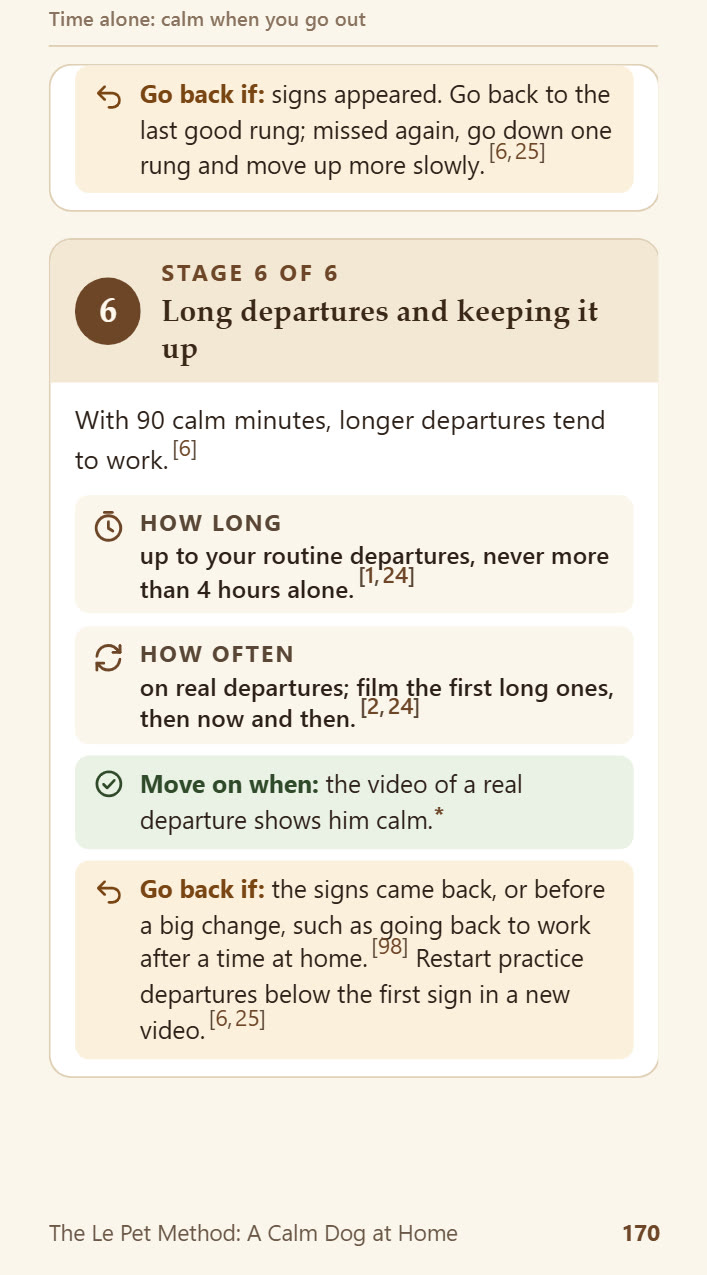
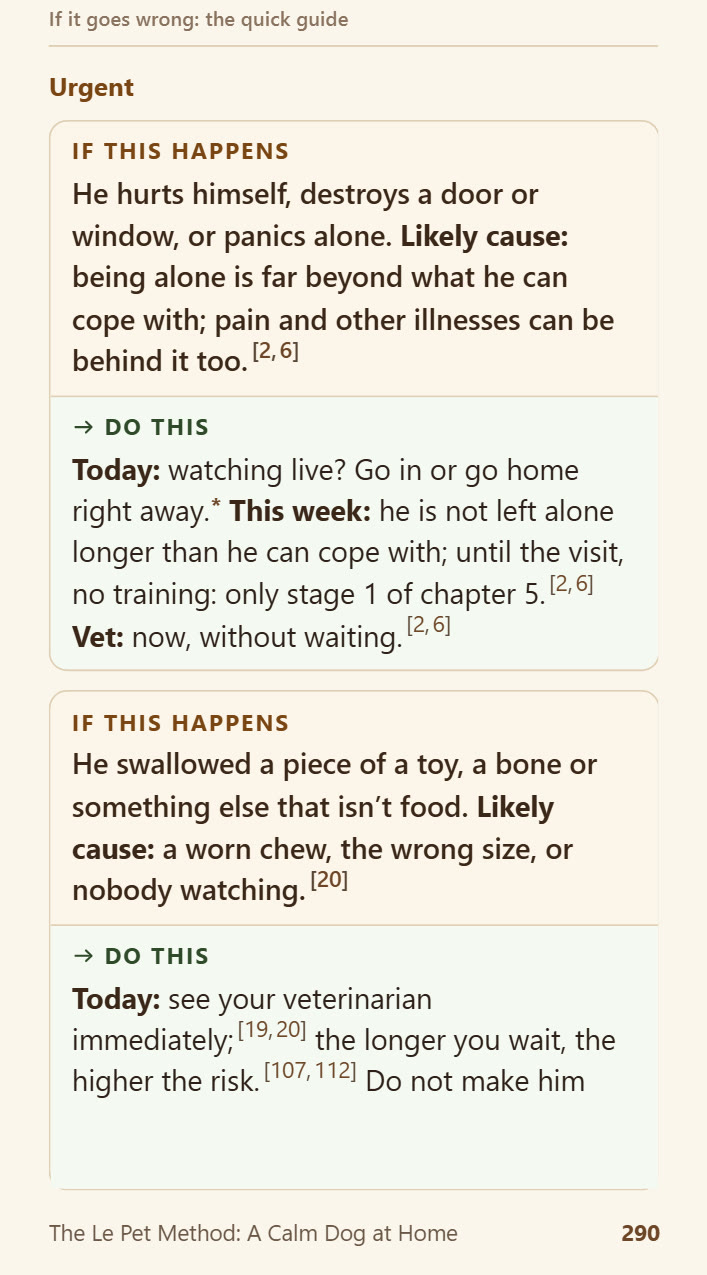
    For an adult dog, a video of a 30- to 40-minute departure shows the minute of the first problem sign, if there is one. Practice starts below it and moves up in small steps, as far as 90 minutes, at the pace the dog shows, without leaving him alone longer than he can cope with. A dog who has panicked, hurt himself or destroyed a door or window when alone sees the vet first, with no video.

    Chapter 5 · 10 cards · 38 pages in A5

  • Destruction

    Coming home to a torn couch cushion.

    Seven clues to why he chews, such as puppy teeth, boredom or the whole household chasing him when he grabs something. Then the right chew in 5 rules, the stuffable toy in 2 levels and a calm way to trade what he grabs for one of his chews, and when to step back instead.

    Chapter 6 · 5 cards · 15 pages in A5

  • Overexcitement

    He races around the house in the late afternoon, jumps on whoever comes in and won’t lie down, even with everyone on the couch.

    A pause every 5 to 10 minutes of lively play, something to sniff, chew or lick after every peak, the leash at peak moments and “Breathe”, taught while he is calm. With visitors, the first minute follows a timed routine.

    Chapter 7 · 4 cards · 11 pages in A5

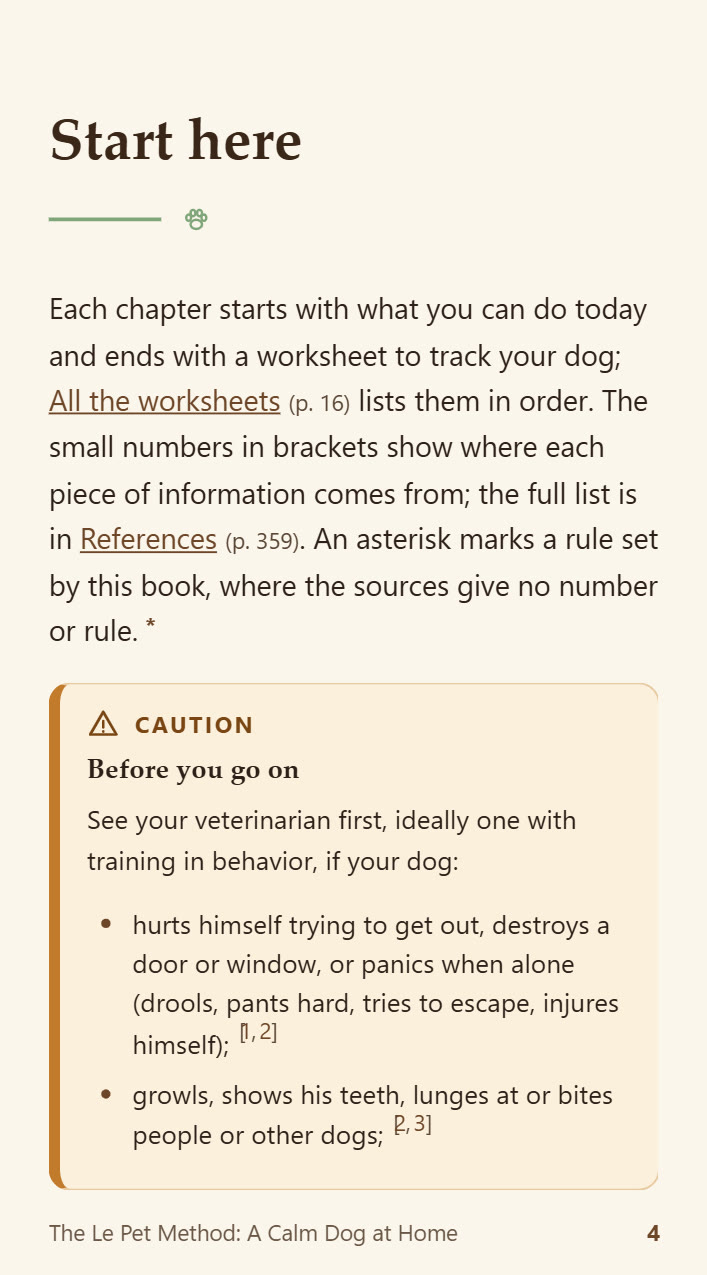
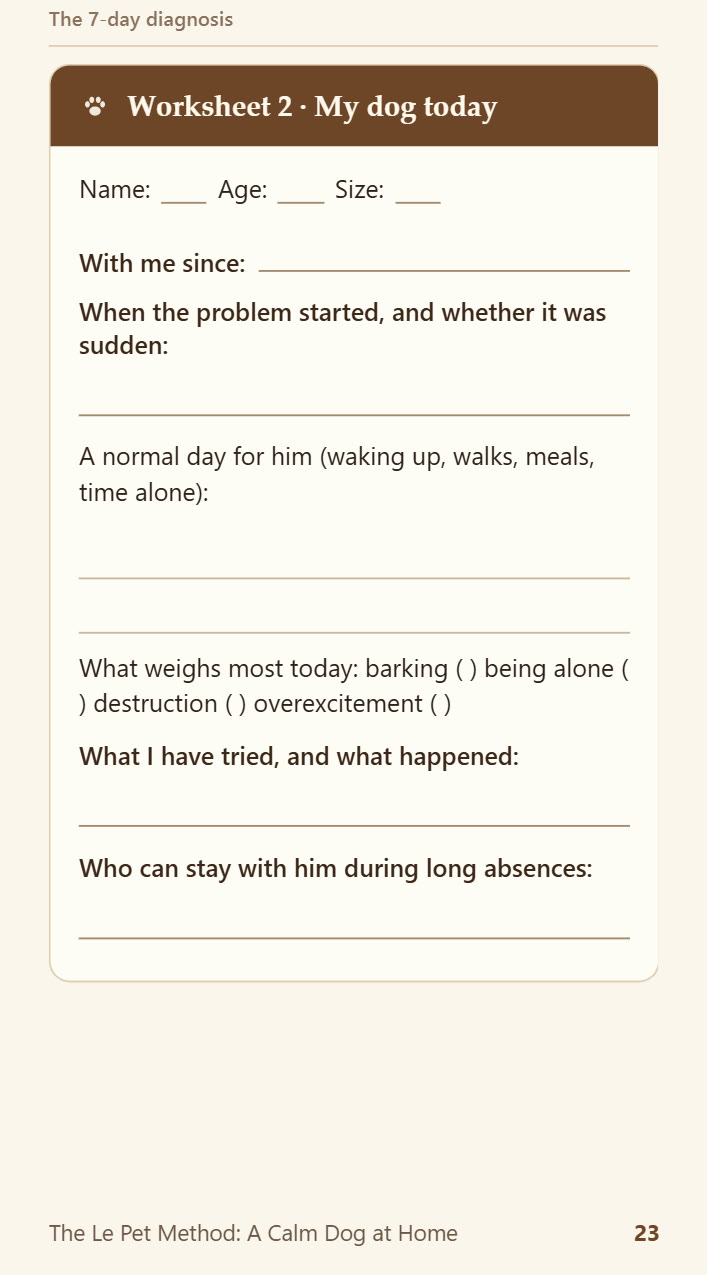
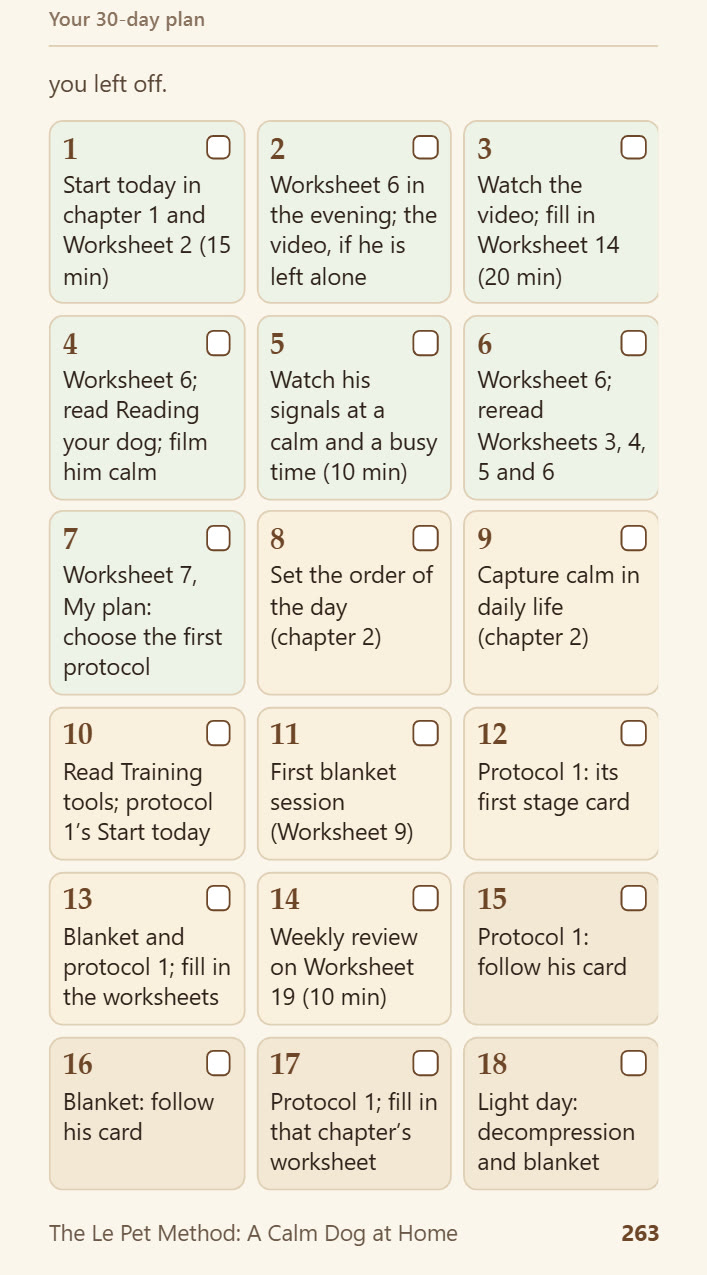
Real pages from the book

Six pages from the phone edition

On a phone, this edition reads without zooming. Swipe to browse and tapClick a page to enlarge it.

A person sitting on a chair drops a small treat near the dog, who lies relaxed on a blanket, on a loose leash

How you will use it

  1. 01

    Tonight

    “Start here” gives you 5 steps for today, such as closing the curtain on the window where he watches the street and agreeing with everyone at home: nobody scolds, and whoever sees the dog lying down and calm drops a treat near him (the book says when to skip this and see the vet first).

  2. 02

    Days 1 to 7

    Each bout of barking goes on Worksheet 3 and each bit of damage on Worksheet 4. If he is left alone, you film a departure; a puppy, or a dog who has panicked, hurt himself or destroyed a door or window when alone, is not filmed. On day 7, Worksheet 7 names your first protocol.

  3. 03

    Weeks 2 to 4

    In week 2 come the daily routine, the blanket and the first card of the protocol you chose. In week 4, a second protocol, if Worksheet 7 calls for it and the first is already routine. Each stage card says when to move on or go back; the calendar only organizes the week.

Puppy or adult

With a puppy, the book starts with prevention

On the first night, you sleep in his room, with a potty break before bed. Then you move your bed a little farther away every few nights, at his pace. The puppy plan has 4 phases, and time alone always stays shorter than the time between potty breaks. Each protocol has its own puppy section, such as teething.

A tan mixed-breed puppy asleep on a small bed inside a playpen

What’s in the book

The contents, with the page where each part starts in the A5 edition.

  1. Start here

    What to do today, when the vet comes first, getting the whole household on board and the 5 rules of the method.

    p. 3
  2. 1

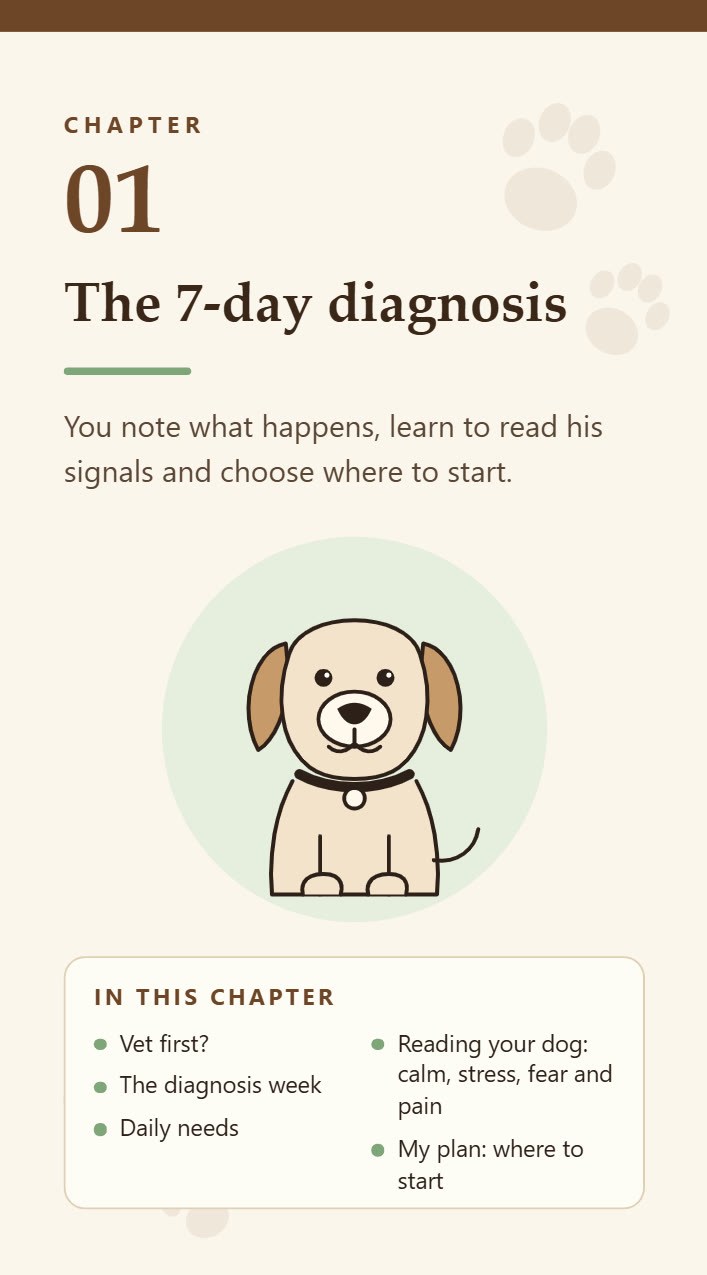
    The 7-day diagnosis

    Worksheets 2 to 7, reading your dog’s signals and the video of him alone. On day 7, your plan.

    p. 14
  3. Training tools

    The “Yes!” that marks the right moment, which treats to use and how to give them, the rules for every session, counting seconds, and “Stay” with “Free” to release.

    p. 33
  4. 2

    The Le Pet foundation: routine, needs and calm

    The daily routine, sleep and walks, hot weather, scatter feeding, the muffin tin, the stuffable toy and calm training on the blanket.

    p. 44
  5. 3

    Instead of scolding

    What to do instead of scolding, water sprays, shaker cans and shock or spray collars.

    p. 66
  6. 4

    Barking: a protocol for each reason

    Window and hallway, doorbell and intercom, visitors, asking for attention, fear, the night and the car, and what to do if the neighbors have already complained.

    p. 69
  7. 5

    Time alone: calm when you go out

    The video of your departure, protecting him while he learns and gradual departures. With the puppy phases.

    p. 107
  8. 6

    Destruction and chewing

    Why he chews, the right chew, the stuffable toy and teething.

    p. 145
  9. 7

    Overexcitement: when he never switches off

    Pauses, decompression, “Breathe” and jumping on visitors.

    p. 160
  10. Your dog, your home: what changes

    Senior dogs, adopted adults, size, high-energy and flat-faced breeds, children at home, two or more dogs, a yard, grooming and vet visits, working from home and big changes.

    p. 171
  11. 8

    Your 30-day plan

    A day-by-day calendar and a weekly review.

    p. 186
  12. Cases from start to finish

    Two invented examples, from diagnosis to a plan in motion: a dog who struggles alone and a senior who barks at night.

    p. 201
  13. 9

    If it goes wrong: the quick guide

    31 slips, by topic: urgent cases, any protocol, reading your dog, methods and devices, time alone, destruction and overexcitement, and more, with what to do in each.

    p. 205
  14. Questions every owner asks

    Methods and devices, why he does it, routine and home, health, medication and products.

    p. 220
  15. Ready-made scripts

    Messages for people who come into your home and for family who can help during the week.

    p. 226
  16. When to get professional help

    Which professional for which problem, how to choose a trainer, what to bring to the vet visit, and dog walkers, pet sitters and daycare.

    p. 229
  17. Shopping list

    What is worth buying, what is optional and what to leave in the store.

    p. 238
  18. Glossary

    The book’s words, explained.

    p. 242
  19. If you want to know more

    Where the main rules come from, chapter by chapter, and where the book is stricter than its sources.

    p. 245
  20. References

    The list of all 129 references cited in the text.

    p. 257

Every piece of advice shows where it came from

In the book, a number in brackets leads to the source of each piece of advice. Where no source gives a number or rule, an asterisk marks that the rule is the book’s own. The list has 129 references: Dogs Trust and the RSPCA, from the UK; the ASPCA, the AAHA and the AVSAB, from the US; published studies; and veterinary reference books, such as the Merck Veterinary Manual. Where the book is stricter than its sources, it says so. The ASPCA, for example, includes holding the dog’s muzzle in its “Quiet”; for “Quiet”, this book uses treats only.

No punishment

Scolding, water sprays, shaker cans and shock or spray collars are out. The AVSAB, the American Veterinary Society of Animal Behavior, says such methods should not be used under any circumstances. Chapter 3 shows what to do instead.

When the vet comes first

A dog who hurts himself when left alone, destroys a door or window trying to get out, growls or bites, or changed suddenly. The book sends him to the vet first and says what to do until the visit.

Who wrote it

Why I created the Le Pet Method

I started veterinary school thinking that was my path.

About halfway through, I realized something: it wasn’t about treating disease. It was about understanding behavior.

While I was still in school, I started Casa Le Pet.

Watching dogs up close, every day, I began to see patterns.
When the structure changed, the behavior changed.

That is where the Le Pet Method came from.
Not to “fix” dogs, but to teach owners to build the right foundation.

The Le Pet Method / Casa Le Pet

PDF e-book

The Le Pet Method: A Calm Dog at Home

Barking, time alone, destructive chewing and overexcitement: the complete, punishment-free plan for puppies and adult dogs.

  • Two PDF editions: one to read on your phone, without zooming, and one in A5 to print.
  • 272 pages in the A5 edition, 9 chapters and 61 stage cards.
  • A 7-day observation week (the book’s “7-day diagnosis”) and a 30-day plan on a calendar.
  • 23 worksheets to fill in, a “For the fridge” sheet and the “If it goes wrong” quick guide, with 31 situations.
  • For puppies and adult dogs, in a house or an apartment.

Away all day? He will need someone during the day; chapter 5 explains how to arrange care around what he can cope with. Dogs Trust and the RSPCA, UK animal-welfare charities, talk about up to 4 hours alone for an adult dog who is already relaxed when alone.

US$29.90

one-time payment, no subscription

Get the Le Pet Method
  • Access by email once your payment is confirmed
  • Paid once, in US dollars, through Kiwify
  • 7 days to change your mind and ask for a refund

Frequently asked questions

What format is it?

It’s an e-book in two PDF editions: one to read on your phone, without zooming, and one in A5 size (about 5.8 × 8.3 in), to print.

How do I get it?

Once your payment is confirmed, Kiwify sends you an email with access to the members’ area. Both PDFs are there to download.

If the email doesn’t arrive (check your spam folder too), write to vendasssd1@gmail.com.

How do I pay?

At Kiwify’s checkout, as a one-time payment in US dollars; there is no subscription. Kiwify may also show the price in your local currency, and any sales tax or VAT is shown at checkout before you pay.

Is it for puppies and adult dogs?

Yes, for both. Where the advice changes with age, such as teething, nights and teaching a puppy to be alone from early on, the e-book explains what changes.

Will I need to use punishment?

No. Yelling, scolding, water sprays, shaker cans and spray, shock or ultrasonic collars are out. Chapter 3 shows what to do instead of each one.

Will I need to buy anything?

The basics: very small treats, a hollow rubber stuffable toy, a few chews sized for him, a blanket or small rug, and a leash clipped to a harness. If he struggles when left alone, also a baby gate or playpen and a towel. Your phone is enough to record the doorbell and film your departure. The book’s shopping list also says what to leave in the store.

How much time will it take each day?

Sessions are short. Practice with the doorbell recording takes 2 to 3 minutes per session, 1 to 3 times a day; “Breathe”, 2 to 5 minutes. In the diagnosis week, the day’s tasks take 5 to 25 minutes, and the video uses a departure you would make anyway. Each stage card says how long, how often, when to move on and when to go back.

I’m away all day. Will it work for me?

The book shows how to teach your dog to be alone a little at a time. But while he learns, he should not be left alone longer than he can cope with. And even afterward, Dogs Trust and the RSPCA, UK animal-welfare charities, talk about at most 4 hours alone for an adult dog who is already relaxed when alone.

So if you are away all day, you will need someone to come by in the middle of the day: family, a neighbor, a dog walker or daycare. Chapter 5 says who to ask, and the book has ready-made messages to ask for help.

How soon will I see a difference?

It depends on the dog and the problem, and the book does not promise a timeline. The 30-day plan organizes the practice, and each card says when to move on and when to go back a step. With attention barking, the book warns that it may get worse at first, when it stops getting a response.

What if it’s not for me?

You can ask for a refund within 7 days of your purchase, through Kiwify.

What if my dog has a health problem?

See a veterinarian before you start. If he is a senior, changed suddenly or started peeing indoors, the book sends him to the vet before training and says what you can do until the visit.

Start tonight.

The curtain closed on the street-facing window, the radio on low, the household on board and Worksheet 2, which takes about 10 minutes. The rest comes one card at a time, at your dog’s pace.

Get the Le Pet Method · US$29.90